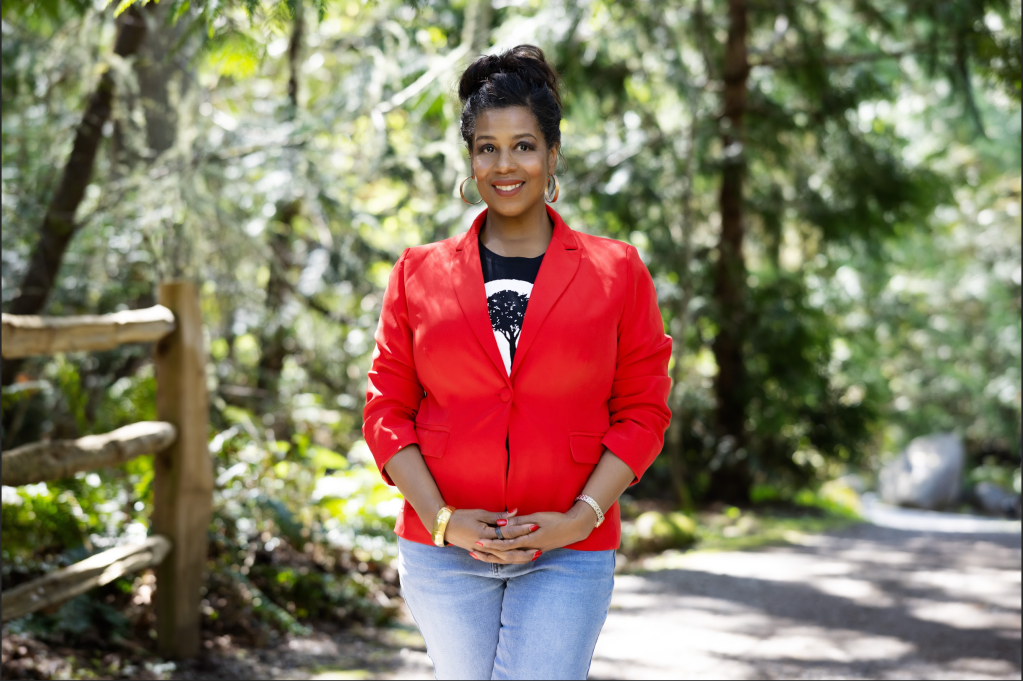
If you have the opportunity to talk with Rue Mapp, one of the first things you’ll notice is how often — and how naturally — she frames the conversation with words like celebration, connection, belonging and joy. Mapp is an author, outdoor fashion designer, and the founder and CEO of Outdoor Afro, a not-for-profit organization that celebrates and inspires Black connections and leadership in nature. When she talks about the organization, it’s as if she’s gently challenging the listener to reframe their own mindset away from deficits and instead recognize and, yes, celebrate how much progress has been made.
Mapp initially launched Outdoor Afro as a blog in 2009, aiming to shift the visual representation and narrative of Black people in nature. Fifteen years later, she’s built Outdoor Afro into a volunteer-led network of more than 60,000 community participants in 60 cities across the United States. The organization annually provides outdoor leadership training for more than 100 volunteers, who then go on to guide 1,200-plus nature adventures in their communities, from foraging to skiing, and kayaking to gardening.
Here, Mapp tells us about that journey. Along the way, she explores the concepts of representation, community and belonging, the meaning of Juneteenth, and how nature can connect us all to joy.
Let’s start with how you came to this work.
It was really organic, in that it was more of an amplification of what I’d grown up with in a family where there is a strong tradition of connecting to nature. And for me, what was special about [that tradition] was obviously a Black family, and a Black family that had migrated from the South and created for themselves a hobby ranch about 100 miles north of where we lived in Oakland, California.
Tell us about those early experiences in nature — what was it like growing up in Oakland and on the ranch in Northern California?
In the Oakland Hills, I was surrounded by the redwoods — there were trails and lots of green spaces to explore. But at the ranch, it was the rolling woodland biome of California that was able to be farmed with livestock. My dad was very much an outdoorsman who hunted and fished, and we had all of the things that you would want in order to explore every aspect of outdoor recreation, including a boat and a garden.
He was also a builder, so he was always working with his hands and creating structures. I had a swing set, and he built a tennis court, eventually. He was very much about creating space for not only himself but for other people to enjoy, and that space became a magnet for people in our family and the community at large for all kinds of togetherness and activities. So that was the blueprint given to me. It was also, for me, very important to experience the celebratory aspects of it, the spiritual and cultural roots of it.
I’m always interested in paths — how did these experiences lead you to founding Outdoor Afro?
As I was growing up, I was excited to pursue many connections to nature. I was into Girl Scouts and various activities that aligned with affinity groups and outdoor exploration. But then as I got older and wanted to do more things in the backcountry, or with other organizations that would meet me at my young adulthood, I found fewer people who looked like me, who shared the cultural experiences I’d had. And the way that it was framed for me in those contexts was very deficit-informed and, really, about the stereotypes that Black people don’t do certain things and we don’t have a relationship with the outdoors. I was working through that for several years. As a young mother, I created opportunities for my own family, like Family Camp with the City of Oakland and other activities, but there was always something missing — I just felt like more of an exception in those spaces.
[Appeared in Finding Nature News]