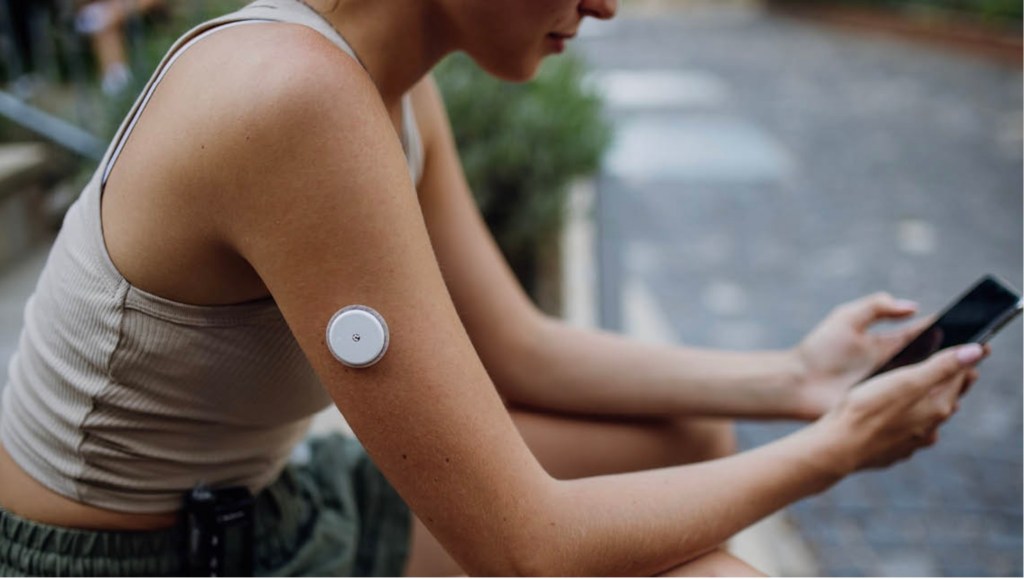
If you’re into biohacking or personalized nutrition — or even if you’re not — you’ve probably heard about continuous glucose monitors (CGMs). These wafer-thin disks stick to the back of your arm, with a tiny wire inserted just below the skin to measure blood-sugar levels. They send minute-by-minute measurements to an app on your phone, which then sounds an alarm if your blood sugar spikes or dips.
CGMs can be useful for anyone who struggles with blood-sugar management — or who wonders whether they do. “We can use CGMs to get a bunch of data about how the body responds not just to how we eat but also to the intervals at which we feed ourselves, and the impact that physical activity and stress have on blood glucose,” says functional nutritionist Jesse Haas, MS, CNS, LN.
When you see and feel how a plate of pasta or a good morning workout affect your blood sugar, she adds, you can start to connect this information to other signals from your body. “That can be really empowering.”
As it happens, Haas is my nutritionist. I sought her out after discovering I had high blood sugar. That was a surprise — but also, it wasn’t.
I grew up in a family that loved food, especially carbs, and toast in particular. At family breakfasts, my grandfather kept a four-slot toaster and a loaf of country white on a bar cart at his elbow. Upon request, he’d send slices of piping hot toast flying down the table. (You want that butter to melt!)
As an adult, my professional life has revolved around writing about food. At home I’ve long maintained a solid Mediterranean diet, and I was a runner for years; for a time these healthy habits were enough to keep the effects of my dining life in check.
Then the day arrived when I got a note from my physician about my recent A1C blood test: It showed my average blood-sugar level in the prediabetic range. I needed to make some lifestyle changes, so I started using a CGM to help me identify which shifts made a helpful impact and which didn’t.
This worked well for me, but metabolic health is complex, and different bodies need different interventions. So, when considering whether to invest time, energy, and money into a CGM, it’s worth pausing to make sure you really need one. These are a few things I learned from using mine.
[Appeared in Experience Life Magazine. Photo courtesy of Experience Life.]



 Pagani & Co.