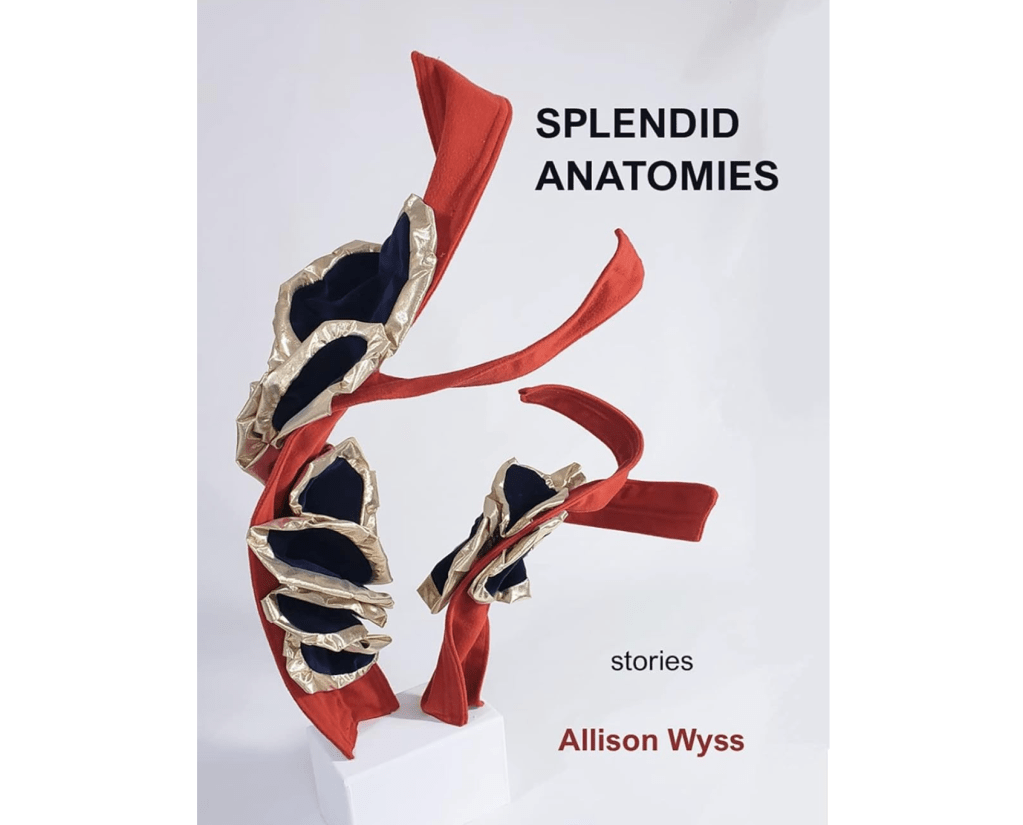
There used to be a horror movie critic in the pink section of the San Francisco Chronicle, Joe Bob Briggs, who would end his reviews with a tally of boobs, bodies, and pints of blood spilled — more being better in all cases. Allison Wyss’s collection Splendid Anatomies is not horror, though it definitely dips a big toe into gory waters, but its proudly quirky short stories are littered with body parts. As I read them, a Joe Bob-ian list formed: a dick, a few boobs, a gallon or two of blood, plenty of entrails, an afternoon of disembodied veins, more than a handful of noses, and an untold universe of ball sacks.
What is Wyss doing with all these body parts? Inviting us to stare at them. Not in a Joe Bob way. Well, okay, in an objectifying way, but as if to say, my god, human bodies are absurdly gross and funny — even as she deftly explores their power and vulnerability.
Let’s start with those veins, the bulging blue ones on the tops of our hands and shins, the ones that don’t get enough fictional attention. In a trio of very short, tight stories, Wyss gives full play to their worm-like nature. In “Garden,” a woman “shuffles” her legs in the “soft and pillowy” earth of her tomato bed, and her veins tunnel out. Here the repeating sounds of the words heightens the unlikely sensuality of the moment: “I moved my legs deeper and scooped handfuls of earth over the mountains of my knees, the slopes of my thighs, until I felt knives and needles through them.”
Wyss’ favors a first person narrator, and what I love about the voice in this story is how it combines the lyricism of the quote above with a slightly dismissive authority. As earthworms rise up out of the soil, the narrator says, “They twisted with the veins so that no one could have told which was which — I couldn’t, and certainly not you — and then hundreds of them nosed through the dirt until they found the holes in my legs, like mouths agape.” It’s startling to have the narrator turn her gaze on us, and yet the brief aside somehow lends a casual air to the sentence, as if she’s talking about something quite ordinary.
In “Fishing,” a girl plucks out her own vein with a hook to bait some “big fish, lucky fish, (old fish)” that have been grazing her worms, and it reads like a subverted parable — no lesson, only sweet revenge. Veins are also prey in the Hitchcock-y “Sleep Birds.” A woman naps on the top of a hill, curled protectively around her baby. “The weight on my chest of sleep descending was the weight of one bird, then another and another, landing, each so light.” This is deeply horrifying, more so when the birds pluck out and eat a vein, but with a quick (and ever more horrifying) shift at the end, Wyss circles back to the very real sleep deprivation and sacrifices of early motherhood.
One of Wyss’ storytelling superpowers is that shift, that subversion, when the plot veers left to undermine either the reader’s gaze or their expectations.
[Appeared in Tupelo Quarterly]

 Pagani & Co.